
Why Business Tax Filing 2025 Matters for Canadian Companies
Business tax filing 2025 involves a complex web of deadlines that vary by business structure. This guide focuses on Canadian rules. OpStart supports startups across the United States and Canada, including cross-border teams. Here’s what you need to know:
- Self-employed & Sole Proprietors: File by June 16, 2025, but pay by April 30, 2025
- Corporations (T2): File within 6 months of fiscal year-end, pay within 2-3 months
- Partnerships (T5013): File by March 31, 2025
- GST/HST: Monthly, quarterly, or annual filing based on your reporting period
- Information Returns (T4, T5): Due February 28, 2025
The Canada Revenue Agency (CRA) imposes significant penalties for late filing: 5% of the balance owing, plus 1% for each month your return is late (up to 12 months). Missing deadlines also triggers interest charges (currently 10% per year) and can increase your audit risk.
For 2025, it’s important to note the capital gains inclusion rate change (now effective Jan 1, 2026), which led to some filing extensions. The landscape also includes new specialized taxes like the Underused Housing Tax (UHT), Digital Services Tax (DST), and Global Minimum Tax (GMT) that may affect certain businesses.
The gap between filing and payment deadlines catches many business owners off guard. For instance, self-employed individuals get until June 16 to file, but any taxes owed must be paid by April 30a full six weeks earlier. Corporations face a similar split, with returns due six months after fiscal year-end but payment required within two or three months, depending on their CCPC status.
I’m Maurina Venturelli. I’ve spent years scaling high-growth companies through IPOs and exits, where mastering tax requirements was essential. At OpStart, we help founders steer these exact deadlines so they can focus on growth, not compliance paperwork.
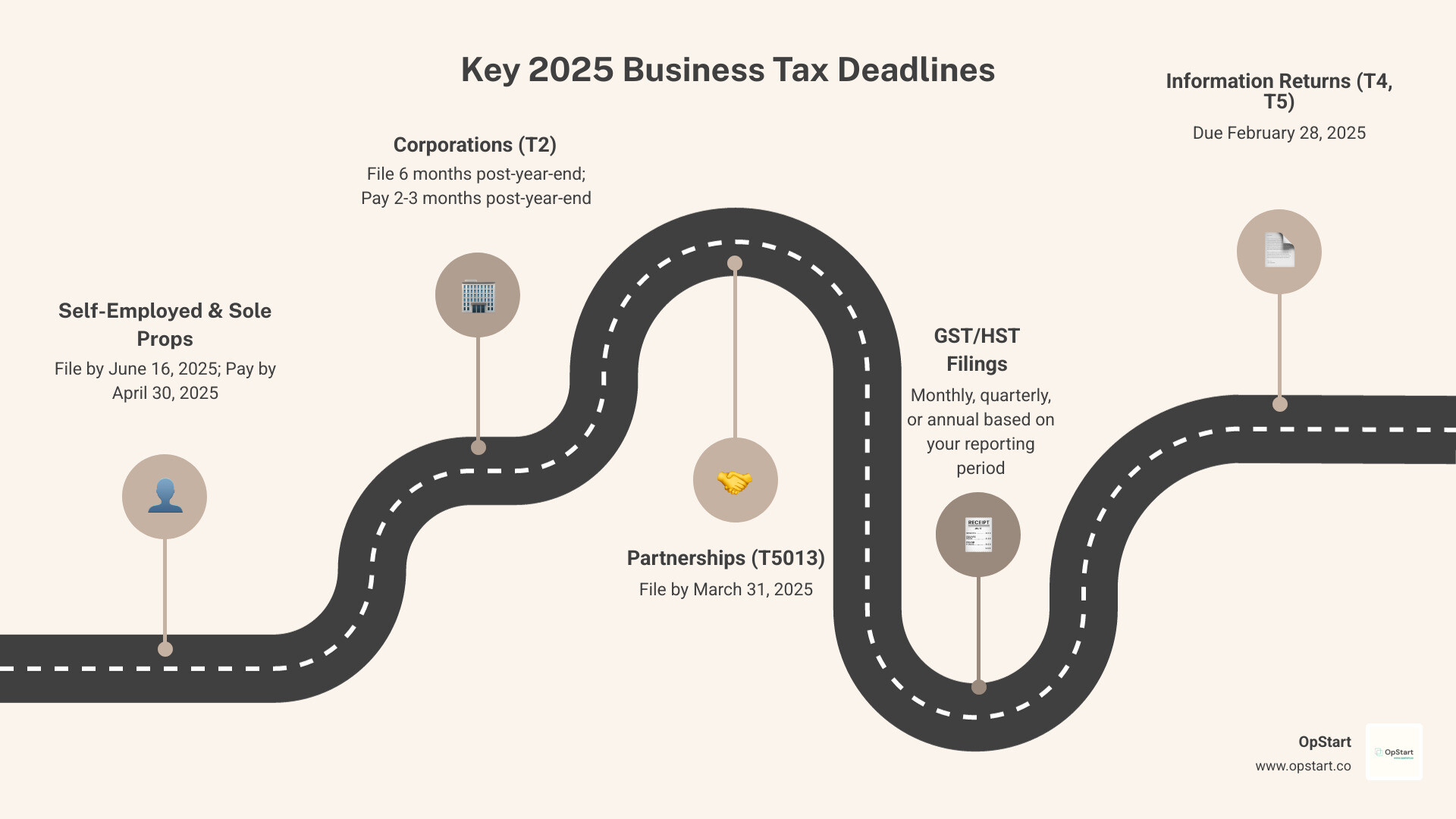
Key 2025 Tax Deadlines by Business Structure
Your business structure has a massive impact on your tax filing and payment deadlines. The Canada Revenue Agency (CRA) sets different dates for each structure, and mixing them up can be costly.
Whether you’re self-employed, in a partnership, or running a corporation or trust, knowing your deadlines is key to compliance. If you’re still choosing a structure, our guide on Choosing Your Business Structure: C-Corp vs. LLC can help.
Let’s break down what business tax filing 2025 looks like for each structure.
Self-Employed Individuals & Sole Proprietorships
As a self-employed individual or sole proprietor, you’ll file a T1 General income tax return, which includes Form T2125 (Statement of Business or Professional Activities).
For the 2024 tax year, most Canadians file by April 30, 2025. But if you’re self-employed, the CRA gives you until June 16, 2025, to file (since June 15 is a Sunday).
Here’s the tricky part that trips up many owners: your payment deadline is still April 30, 2025. While you get extra time to file, any taxes owed must be paid by April 30. If you miss the payment deadline, you’ll accumulate interest charges, even if you file on time in June.
This split deadline requires planning. Getting your accounting systems right from day one makes tax season easier. Check out Startup Accounting Services: What Founders Need to Know for guidance.
Partnerships
Partnerships are flow-through entities, meaning the partnership itself doesn’t pay income tax. Instead, each partner reports their share of the partnership’s income or loss on their own T1 or T2 tax return.
However, the partnership must file a T5013 Partnership Information Return. This form tells the CRA and your partners how to report their share of income and expenses.
For the 2024 tax year, the T5013 is generally due by March 31, 2025. This applies when partners are individuals, trusts, or professional corporations. If all partners are corporations (excluding professional corporations), the T5013 is due five months after the partnership’s fiscal year-end.
Corporations (T2 Returns)

Corporations are separate legal entities that file a T2 Corporation Income Tax Return. Corporate deadlines are tied to your corporation’s fiscal year-end, which you choose when you incorporate.
Your T2 filing deadline is six months after your fiscal year-end. A corporation with a December 31, 2024, year-end has until June 30, 2025, to file.
The payment deadline differs from the filing deadline. Generally, taxes are due two months after your fiscal year-end. However, Canadian-Controlled Private Corporations (CCPCs) claiming the Small Business Deduction get an extra month, with taxes due three months after year-end, provided their taxable income is below the small business limit.
This extra month can be a lifeline for startups managing tight cash flow. A CCPC with a December 31, 2024, year-end would pay by March 31, 2025, instead of February 28. If you’re curious about corporate structures, What is a C Corporation? provides useful context (though it’s specific to U.S. entities).
Trusts (T3 Returns)
Trusts, while less common, have unique tax filing requirements. A trust is a legal arrangement where a trustee holds property for beneficiaries.
Trusts file a T3 Trust Income Tax and Information Return. For inter-vivos trusts (created during a lifetime) with a December 31, 2024, year-end, the filing deadline is March 31, 2025. Testamentary trusts (created via a will) have returns due 90 days after their fiscal year-end.
Trust taxation includes complex concepts like deemed dispositions, where a trust is considered to have sold property at fair market value even if no sale occurred. This can trigger significant tax bills, making planning essential. The intricate rules for trusts often require professional support for business tax filing 2025.
Navigating Other Critical Business Tax Filing 2025 Deadlines
Beyond your main income tax return, Canadian businesses must manage other filings, including information returns, payroll remittances, and specialized taxes. Understanding the rhythm of these deadlines makes them more manageable.
Let’s walk through the most important ones for business tax filing 2025.
GST/HST and QST Filing and Payment
If you’re registered for GST/HST (and QST in Quebec), you must regularly remit the sales tax you’ve collected and claim input tax credits on your business expenses.
Your filing frequency depends on your annual taxable sales. Monthly and quarterly filers must file and pay one month after the end of each reporting period. Annual filers have three months after their fiscal year-end to file and pay.
If you’re self-employed with a December 31 year-end, your GST/HST return is due by June 16, 2025, but any tax owed must be paid by April 30, 2025—the same split deadline as your income tax.
If your net GST/HST exceeds $3,000 for two consecutive years, you may need to make quarterly installment payments. Missing these deadlines can trigger penalties and interest, as detailed in the CRA’s guidance on GST/HST penalties and interest.
Payroll and Information Returns (T4, T5, NR4)
If you have employees or make certain payments, you must issue information slips to recipients and the CRA. These are essential for tracking income within the tax system.
The main deadline is February 28, 2025. This is when T4 slips (employee wages), T4A slips (pension, annuities), and T5 slips (investment income) must be filed and distributed. The CRA often provides relief from late-filing penalties for returns filed by March 7, 2025.
If your business makes payments to non-residents, you’ll file NR4 slips by March 31, 2025. These payments often involve withholding tax, so accuracy is crucial. Getting payroll right makes these filings easier; our guide on Mid-Year Payroll Provider Changes can help you steer transitions.
Specialized and Emerging Tax Deadlines for 2025
The Canadian tax landscape is always evolving. For 2025, several specialized obligations might affect your business, though many target larger corporations.
- Underused Housing Tax (UHT): A 1% annual tax on vacant or underused residential property. Even if exempt, a return may be required. Form UHT-2900 is due by April 30, 2025, for the 2024 calendar year.
- Scientific Research and Experimental Development (SR&ED): These claims for valuable tax credits are filed using Form T661, due 12 months after your main tax return deadline (18 months from fiscal year-end for corporations). Our R&D Tax Services team can help maximize these claims.
- Mandatory Disclosure Rules: Certain transactions require reporting via Form RC312 (Reportable Transactions) or RUTT (Reportable Uncertain Tax Treatments). These rules target aggressive tax planning and have specific deadlines.
- Other Major Corporate Taxes: Large or multinational corporations should also be aware of the Excessive Interest and Financing Expenses Limitation (EIFEL) rules, the Digital Services Tax (DST), and the Global Minimum Tax (GMT).
While most startups won’t face these more complex rules initially, rapid scaling or international operations can change that. Staying informed and seeking professional guidance is key.
Consequences of Late Filing and Best Practices for Compliance
Ignoring tax deadlines is a costly mistake. The CRA takes late filings and payments seriously, and the financial consequences can add up quickly, which is especially painful for startups where every dollar matters.
Understanding the Penalties for Missing Your 2025 Business Tax Filing
The CRA’s penalty structure is designed to motivate compliance. If you file late and owe money, you’ll face a late-filing penalty of 5% of your balance owing, plus an additional 1% for each full month your return is late, up to a maximum of 12 months.
For example, if your business owes $10,000 and you file six months late, the penalty would be $1,100 (5% + 6×1%). That’s money that could have been invested back into your business.
Beyond penalties, the CRA charges interest at a prescribed rate of 10% per year on any unpaid taxes, compounding daily. The CRA will also hold any refunds or credits until you file, and late filing can flag your business for an audit.
Good record-keeping is your best defense. Our team at OpStart specializes in Bookkeeping for Start-ups to help you stay organized and audit-ready.
Key Tax Changes and Considerations for 2025
Staying informed about tax changes is crucial. A major development affecting business tax filing 2025 is the capital gains inclusion rate.
The capital gains inclusion rate change is now effective January 1, 2026. For the 2024 tax year (filed in 2025), the inclusion rate remains 50%. However, the debate around this change led to temporary filing deadline extensions for some taxpayers.
For 2024 tax returns potentially impacted by this, T1 individual filers received an extension to June 2, 2025, and T3 Trust filers got until May 1, 2025, to file without penalties. These extensions were specific to the 2024 tax year, so always confirm current deadlines with the CRA or a tax professional.
Best Practices for a Stress-Free Tax Season
A stress-free tax season is possible with the right habits. Here are some best practices we recommend to our clients at OpStart:
- Accept digital record-keeping. Ditch the shoebox of receipts. Cloud accounting software keeps your records organized, accessible, and safe, making tax time much simpler.
- Set calendar reminders. Mark all tax deadlines in your calendar with multiple alerts to ensure nothing is missed.
- Separate business and personal expenses. Use dedicated bank accounts and credit cards for your business. This simplifies bookkeeping, clarifies deductions, and avoids issues with the CRA.
- Understand your fiscal period. Know whether you operate on a calendar or fiscal year, as this determines most of your deadlines.
- Know your accounting method. Whether you use the cash method or accrual method impacts your financial statements and tax calculations. Our guide on Cash vs. Accrual Accounting can help you decide.
- Seek professional tax support. A qualified professional provides immense value by navigating complex rules, identifying deductions, ensuring compliance, and representing you if needed. For growing startups, this guidance is invaluable and often pays for itself.
Frequently Asked Questions about Business Tax Filing in Canada
Tax season brings many questions. Let’s tackle some common points of confusion about business tax filing 2025 to help you avoid costly mistakes.
What is the difference between a tax filing deadline and a tax payment deadline?
This distinction is one of the most important things to understand about Canadian tax deadlines.
Your filing deadline is when you must submit your completed tax return to the CRA. It’s about providing information.
Your payment deadline is when any taxes you owe must be paid to the CRA. It’s about sending money.
These dates are often different. For example, self-employed individuals can file by June 16, 2025, but must pay any tax owed by April 30, 2025. Corporations also have a split deadline: six months to file their T2 return but only two or three months to pay.
Missing the payment deadline triggers interest charges immediately, even if you file on time.
What happens if a tax deadline falls on a weekend or holiday?
The CRA offers some flexibility here. When a deadline falls on a weekend or public holiday, it automatically extends to the next business day. So, if a deadline is on a Sunday, your return or payment is on time if the CRA receives it or it’s postmarked by Monday.
Do I need to make instalment payments?
This is a common question for self-employed individuals and growing corporations.
The general rule is that you must make tax instalment payments if your net tax owing exceeds $3,000 in the current year and in either of the two preceding years. For Quebec residents, the threshold is $1,800.
For individuals, instalments are due quarterly: March 15, June 15, September 15, and December 15. Corporations typically make monthly or quarterly payments. The CRA usually sends reminders, but the obligation exists regardless. Instalments help you avoid a large tax bill and prevent interest charges for underpayment.
Conclusion: Get Expert Help with Your 2025 Tax Filings
Navigating business tax filing 2025 in Canada is complex. With split deadlines for the self-employed, different timelines for corporations and partnerships, and a growing list of specialized taxes, it’s easy to feel overwhelmed. We work with startups throughout the United States and Canada, including cross-border teams.
We’ve covered the critical datesfrom the self-employed payment deadline of April 30 to corporate, partnership, and information return due dates. We’ve also highlighted the steep financial consequences of missing them, including a 5% late-filing penalty plus compounding interest.
Staying compliant is essential for your financial health. It protects you from penalties and ensures you maximize deductions. However, it’s also time-consuming work that pulls you away from what matters most: building your business.
You didn’t start your company to become a tax expert. You started it to solve a problem or disrupt an industry. That’s where your energy should go.
At OpStart, we handle the full spectrum of financial operations for startupsfrom bookkeeping and accounting to tax filings and CFO supportall at a flat rate. We integrate seamlessly with your existing software stack, like QuickBooks or Xero. Our expert-managed approach means you get hands-on support from professionals who understand the startup world.
When tax season arrives, we’re already prepared. We track your finances year-round, keep records organized, and monitor CRA changes. This turns your business tax filing 2025 into a smooth, stress-free process.
Ready to get back to building your business? Let us handle the numbers while you focus on growth. Explore our Expert tax services for startups and find how OpStart can take tax season off your platefor good.